7 Steps to Start Forex Trading for Beginners Without Blowing Your First Account
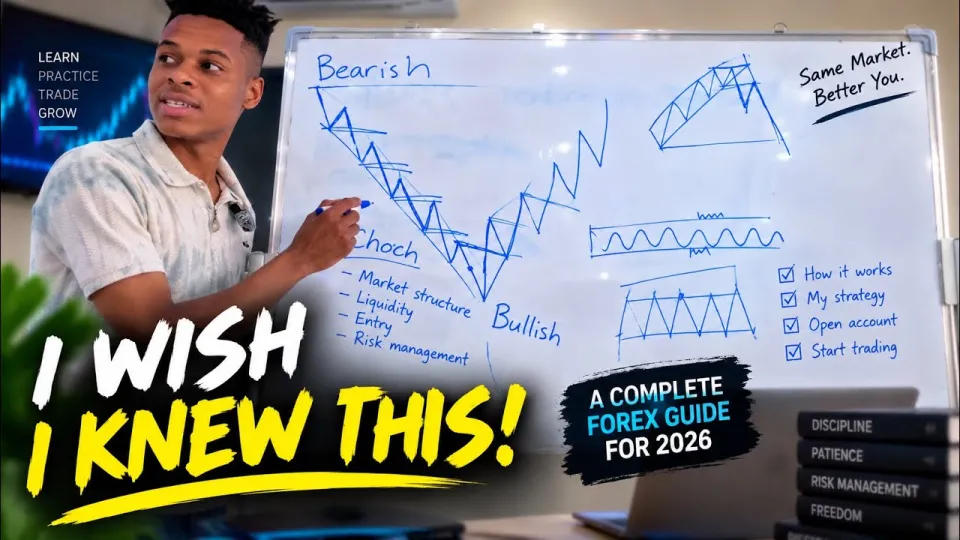
Video: How To Start Forex Trading For Beginners in 2026 (Full Guide + My Strategy)
Want articles like this for your own video to promote it on YouTube and Google? Order them through the Telegram bot @sat_sit_bot. The bot writes and publishes the articles itself (with your YouTube video embedded) on popular topical websites (no ads). Try it free: 50 articles on us.
· based on the channel Carl Fx
Key takeaways
- Forex is an over-the-counter market where currencies are quoted in pairs such as EUR/USD; there is no central exchange and trading runs 24 hours, five days a week.
- A standard lot is 100,000 units of the base currency, and with 1:100 leverage a 1% move against a 0.10 lot position costs about $100 of account equity.
- Beginners should start on a demo account for at least 1–3 months and risk no more than 1–2% of equity per trade once real money is involved.
- Market structure — higher highs and higher lows versus lower highs and lower lows — is the foundation of price action trading before any indicator is added.
- Most first-account failures come from overleveraging, revenge trading after a loss and moving stop losses, not from a lack of strategy.
Forex trading is the buying and selling of currency pairs on an over-the-counter market that runs 24 hours a day, five days a week, and a beginner starts by learning how pairs are quoted, opening a demo account with a regulated broker, studying market structure and risking no more than 1–2% of the account per trade. You can open a live account through TFC Global Markets registration, the broker linked by Carl Fx in his beginner walkthrough, but the order of the steps below matters more than the platform you pick.
What forex trading actually is and how the market is structured
Forex is a decentralised network of banks, brokers and retail traders where currencies are always traded in pairs, so every position is simultaneously long one currency and short another. When you buy EUR/USD at 1.0850, you are buying euros and selling dollars, and the profit or loss is measured in the quote currency (US dollars in this case).
Four facts shape everything else a beginner does:
- The market has no single exchange and no closing bell; it moves from the Sydney session through Tokyo, London and New York.
- The most liquid pairs — EUR/USD, USD/JPY, GBP/USD, USD/CHF — carry the tightest spreads and the most reliable price action.
- Volume is not centralised, so tick volume from your broker is a proxy, not a true measure of market participation.
- Currency prices are driven by interest rate decisions, inflation prints, employment data and risk sentiment, which is why the economic calendar is part of the job, not an optional extra.
Position size is the number most beginners ignore. A standard lot is 100,000 units of the base currency, a mini lot is 10,000 and a micro lot is 1,000. With 1:100 leverage, a 0.10 lot position on EUR/USD moves roughly $1 per pip, so a 100-pip move against you costs about $100 — a large slice of a $500 starter account.
How to open a trading account and what to check first
Opening a trading account takes minutes, but verifying the broker takes longer and matters more than the sign-up form. The process is: register, complete identity verification, choose an account type, fund it, and only then place a first trade — ideally on demo first.
Before depositing anything, confirm four things:
- Regulation: the broker should be licensed by a recognised authority and publish its registration number.
- Spread and commission: compare the all-in cost on EUR/USD during the London session, not the advertised "from" figure.
- Leverage and margin rules: higher leverage increases risk per pip; many beginners are better served by 1:30 to 1:100 than by 1:500.
- Withdrawal terms: how long payouts take and whether any bonus locks your capital.
Carl Fx is transparent that he owns the brokerage he promotes, which is worth knowing when you evaluate any referral link: the recommendation and the commercial interest sit in the same place. Use a demo account for at least one to three months and treat it as a skills test, not a game — same position sizes you would use with real money, same journal.
Reading bullish and bearish markets through market structure
Market structure is the sequence of swing highs and swing lows that tells you which side of the market is in control. An uptrend prints higher highs and higher lows; a downtrend prints lower highs and lower lows; anything else is a range, and ranges punish trend-following entries.
A workable beginner routine looks like this:
- Open the daily chart and mark the last three or four swing points.
- Label the sequence: bullish, bearish or ranging.
- Drop to the four-hour chart and mark the levels where price previously reversed — those are the zones you care about.
- Only look for buys in a bullish structure and sells in a bearish one until the sequence breaks.
A structure break — a lower low inside an uptrend, for example — is the earliest objective signal that the trend may be changing. It is not a trade by itself; it is a reason to stop taking trades in the old direction.
A simple forex strategy a beginner can practise
The simplest strategy that survives contact with real markets combines a structural bias, a pullback into a marked zone and a defined stop. It has three parts and no indicators are required.
- Bias: direction taken from the daily chart structure.
- Entry: wait for price to pull back into the last area of consolidation or the previous swing level, then look for a rejection candle such as a pin bar or engulfing pattern on the four-hour or one-hour chart.
- Risk: stop loss beyond the swing that created the setup, target at the next structural level, and a minimum reward-to-risk of 1:2 so a 40% win rate can still be profitable.
Write the rules down before you trade them and backtest at least 50 setups on historical charts, then 30 more on demo in live conditions. The point of the exercise is not to find a holy grail but to learn how the strategy behaves across trending and choppy weeks, and to build the sample size that tells you whether the edge is real.
Risk management rules that keep a beginner account alive
Risk management is the only part of trading a beginner fully controls, and it decides survival more than entry quality does. Two traders can take the same setups and end the year in different places purely because of position sizing.
Apply these limits from day one:
- Risk 1% of equity per trade while learning, and never more than 2%.
- Cap total open risk across correlated pairs — long EUR/USD and long GBP/USD is close to one dollar-short trade, not two.
- Set a daily loss limit (for example 3% of equity) and stop trading when it is hit.
- Keep a journal with entry reason, screenshot, result and emotional state; review it weekly.
- Never add to a losing position and never widen a stop loss to avoid being taken out.
A $500 account risking 1% has $5 of risk per trade, which is a few micro lots on a 50-pip stop. That feels slow, and that is the point: the first year is about proving the process, not compounding a small balance into a fortune.
Common beginner questions and mistakes worth avoiding
Most beginner problems repeat across accounts, and the questions in the comments under beginner guides show the same pattern: people want to start immediately, struggle with opening a live account, and ask for chart examples because the theory has not yet connected to a picture.
Typical mistakes:
- Skipping demo: going live in week one and donating the deposit to spread and emotion.
- Overtrading: taking five setups a day because the platform is open, rather than one or two that fit the rules.
- Revenge trading: doubling size after a loss to "get it back", which is how a bad day becomes a blown account.
- Indicator stacking: adding five oscillators before market structure is understood; they all repaint the same price.
- Ignoring the calendar: holding a position through a central bank decision or a US payrolls release without planning for the spike in volatility and spread.
On the practical side, if live account verification stalls, the usual causes are a mismatched name on the document, an expired ID or an unaccepted proof of address — resolve those with support before funding. And when a concept does not click from text, the fix is chart time: open the pair, mark the swings, and compare the result with a worked example.
Useful links
- Open a live account with TFC Global Markets — the broker and sign-up link shared by Carl Fx in the guide.
- Carl Fx free Telegram community — the channel's free group for trade discussion and questions.
Bottom line
Forex rewards patience and process far more than enthusiasm, and the seven steps above — understand the market, verify a broker, learn structure, adopt one simple strategy, control risk, journal results and avoid the classic mistakes — are the whole foundation. Carl Fx frames the same idea in his beginner guide: trading is not about getting rich overnight but about discipline, risk control and daily improvement, and he is upfront that he owns the brokerage he recommends. Start on demo, prove the process with a written plan, and only scale risk once the journal shows consistency. Same market, better preparation.
Source: How To Start Forex Trading For Beginners in 2026 (Full Guide + My Strategy) · Markdown version
Questions & answers
How much money do I need to start forex trading?
You can open many accounts with $100–$500, but the amount matters less than the risk per trade. With a $500 balance and 1% risk, you have $5 of risk per trade, which allows only micro lots. A larger account simply lets you trade normal position sizes without breaking the 1–2% rule.
How long should I stay on a demo account before going live?
Plan for at least one to three months, and longer if you have not yet logged 30–50 setups with a written plan. Demo removes financial pressure, so use it to test whether your rules survive choppy weeks, then move to a small live account rather than jumping straight to a full-size deposit.
Is forex trading gambling?
It becomes gambling when position size is arbitrary, stops are absent and decisions follow a loss rather than a plan. Traded with a defined setup, a fixed risk percentage and a journal, it is a probability business where a 40–50% win rate with 1:2 reward-to-risk can be profitable over a large sample.
What is the best time of day to trade forex?
The London session and the overlap between London and New York produce the highest liquidity and the tightest spreads on major pairs such as EUR/USD and GBP/USD. Beginners usually do better in those windows than in the thin Asian session or around major news releases, when spreads widen and price spikes.